In-Home Nursing … Sometimes Hazardous to Nurse’s Well-Being

Nurses are often necessary to treat patients in their own homes.  Oftentimes, such nurses are designated as providing two types of care, palliative and hospice.  Palliative care relates to services  provided in hopes that the person can recover from injury or surgery, for example.  Hospice care is often associated with end of life care, concentrating on the quality of one’s life in terms of comfort and assistance.  
 
They have a tough job, don’t they?  They either are doing their very best to nurse the patient back to health, or trying to help their patient get through the last days of life.  The toll on their days and bodies can be overwhelming at times.
 
Not only that, delivering in-home care can be hampered for reasons having nothing to do with the care itself.  The nurse often needs to bring along equipment, supplies, and medication, in order to do the job.  The ability to bring those items into the patient’s home, in turn, depends on traffic, parking, and weather.  As a result, while such nurses may be scheduled to see a certain patient at a certain date and time, they might be delayed for reasons beyond their control, in terms of traffic and parking to visit the home.  
 
Why does this matter? How, exactly, is this a threat to a nurse’s health, i.e., her/his well-being? Some medical providers set up a schedule identifying how much time a visit should take, and want to pay not a penny more for the visit.  So when one has to take more time, whether they get paid for all that time depends on the nurse’s recording all the hours and minutes needed that day.
 
Nurses!  Document that time, along with heavy traffic, parking problems, or anything that interferes with your ability to get to the patient on time and provide that treatment.  Sooner or later, maybe sooner than you think, you’ll want to be able to show all this time – in case you find yourself shorted, whether it’s for straight time or overtime. If you depend on your employer to do this, you might need a further check-up on down the line.
 
Employ prophylactic care!  Keep your own complete record (including all unavoidable delays, e.g., traffic, parking, etc.) of all your time worked each day – and do a check-up with your earnings statement from time to time.  You protect others.  Protect yourself.

Warehouse Work! Hot Summers? Cold Winters? Really Long Walks?

Are you working in a large warehouse? New ones are being built all over California and can be over a million square feet in size. We currently have a case involving a warehouse that big. If you work in a warehouse, you’re probably aware on a daily basis of three important factors.

Heat – Is it hot – Really Hot – in the summer, or Way Too Cold in the Winter? California law requires that all work environments be safe in which to work.

Do you have to take your breaks in restricted areas, that require you to work 5-10 minutes or more to get there and back top your workstation?

Do you have to wait in lines while leaving work – after you’ve clocked out? Whether to leave to take a break or to go home for the day or night?

If any of those factors apply to you, your employer may be taking advantage of your health, safety and time, If this is happening to you (or friends or family), perhaps you should contact an attorney.

You’ve worked there a long time. You got good reviews. Then, out of the blue, a 90-day PIP. Where did that come from?

Has this happened to you or someone you know? You’ve enjoyed where you work, always done well, your efforts were appreciated. Then it seems like nothing you do is any good. Suddenly, you’re put on a 90-day period Performance Improvement Plan (PIP). “Improve your work – or you’re out!”

“Wait! What???”

Perhaps your work has suffered, because of ill health, for instance, and you haven’t been doing the fine job you did before.

Or maybe the boss is trying to fire you illegally and the PIP is being used as a means to get rid of you with the pretext that it’s your fault.

Ask yourself. Are you or do you feel like you’re suddenly being discriminated against because of your age? This happens. People 20 years younger than you can decide you don’t know what you’re doing, you’re not up to date, you’re too slow to get the work done, and so they want you out.

Or maybe you’re not of the right religion or race or nationality or belong to some other protected group. If that’s why they want you out, that would be illegal as well.

Whether that’s happening to you or someone you know, when it does, perhaps you should consult an attorney to discuss the facts.

On-call? But Sometimes You’re Left Just Holding the Phone?

Last week’s discussion was about using your phone at work. This week is about being “on-call” – where you might have to use that phone to call in to see about work that day.

There are at least two kinds of “on-call” status.

The obvious one is where you might be called at any time, over a week-end say. You’re able to see to a movie, attend church, go dancing, something personal. But during that time, you have to be available within a certain period of time to start working. If you’re called and have to be at a job location or working within a short period of time, less than a half hour, say, you might be owed wages.

The second is where you might be called into work each day at a certain time, and you have to call in to find out. You have to set aside that time, making your life and monthly pay unpredictable. You have to be ready to go to work that day at that time, unless your boss tells you otherwise.

Are you working under either of those scenarios?

Have you been doing so for a while? Maybe you’re owed back wages for those on-call duty days, and should get legal help to find out. We’d be glad to hear from you.

Using your Phone for Work? Who’s paying the bill?

Whether you’re driving or working at a desk, your employer might have chosen to ask you to use your phone as an everyday tool.

Do you have to use your phone to clock in or out from work? Or to go on or off breaks? How about to communicate with clients of your employer throughout the day? Or to talk with dispatch as they tell you your next stop or drop-off?

You should be getting reimbursed for your phone being used during that time. If you’re not, then perhaps you need to start tracking the calls and time you’re on the phone – especially if it’s before or after you clock in.

Do yourself a favor. Just like with your earning statements, schedule and time sheets, hold onto your phone bills! Maybe one day you’ll be paid for the fact that your phone was a rent-a-tool for your boss.

Bag – and Clothing – and Jacket Checks – Holding You Up?

Last week it was ‘Background Checks.’

This week it’s about ‘Bag Checks.’

Where you work, before you go on a meal break, or when you leave work, do you have to go through a bag check? Do they look in your bag, or make you take off a jacket or coat and hat or cap, to inspect you, because you might take company merchandise?

Do you have to first clock out? And then walk to get in to the security line at the end of a shift? Is the timeclock in the back of the warehouse and the security line in the front? Suppose you bring your lunch, go old school and bring a lunch pail. Do you have to open it up?

Lots of major companies have been sued about the time spent in line for such a bag and clothing check, including Apple, Coach, Converse, Staples, Williams-Sonoma, Tapestry, Stuart Weitzman and TJ Maxx (not to be confused with PJ Masks). Is your employer making you stand in line before you can get to lunch or at the end of your work day? Maybe you’re entitled to off-the-clock unpaid wages.

Background Checks – Read the Fine Print

Probably each time you’ve applied for a job, you’re asked to sign a package of documents. It may even be online, where you’re simply asked to ‘docusign’ what you see on a screen.

If you can, you might want to consider asking to obtain a complete copy of everything you sign. If possible, you might ask if that’s possible even before you first start signing. That way, later on, if HR says you signed something, you’ll have your own copy with which to compare anything you’re shown.

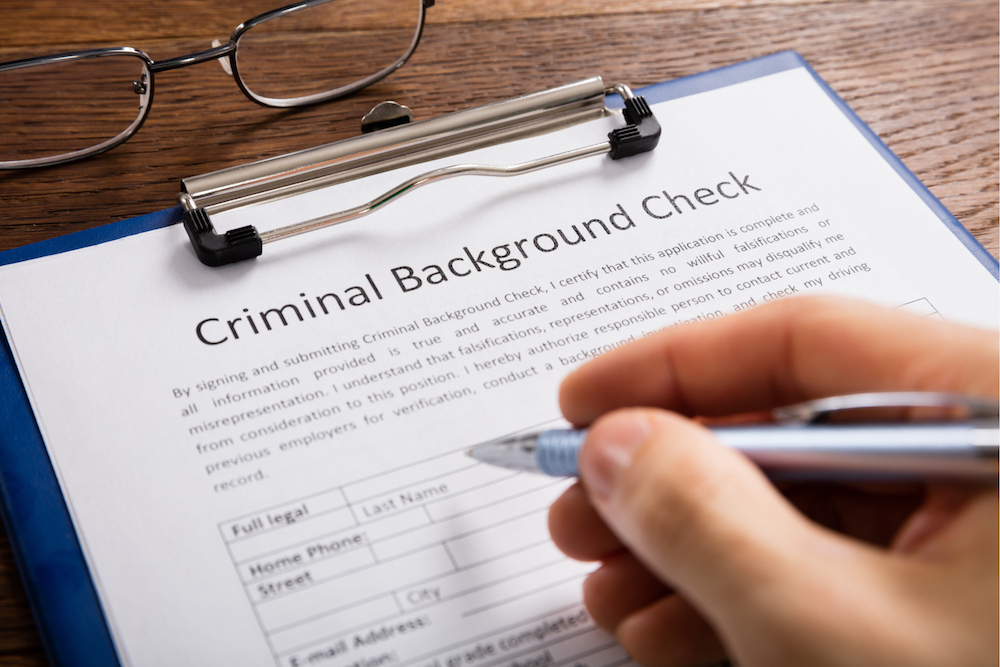
One of the things you might be asked to sign, might be an authorization for the company to do a background check on you. The Fair Credit Reporting Act (FRCA) limits how that can be done. Disclosures about obtaining a background check are supposed to be a stand-alone document so as to not confuse the applicant.

Prospective employees need to watch out for when a company not only asks for permission to search out criminal history but also seeks permission to inquire from other people, schools, companies and businesses. The FCRA requires that employers seeking those things must tell applicants via clear, conspicuous disclosures contained in separate forms.

Would you want to agree that a company could get your permission – in writing – that you authorized anyone at all to give up what might be private information?

Religious Discrimination in Employment – A Quick Overview

As you’re probably aware, religious discrimination in employment is, for the most part illegal. Here are four types of instances where it might arise.

The first has to do with hiring. If, for example, you told a prospective employer that due to your religion you couldn’t work on a Friday or Saturday or Sunday, for example, and a job offer was suddenly withdrawn, that might well be illegal.

Or once you were hired, you might inform your boss that your religion required you to have a certain day available for religious practices and ask to be excused for that time. If it were denied, that could possibly constitute an illegal act by your employer.

Or perhaps you had been working months or years, and had been given a particular day off for religious observances. Suddenly that might cease due to a new manager or company policy. Again, that might give rise to a possible breach of the law.

Finally, your religion might require you to dress in a certain way, or groom yourself in a certain manner. Discrimination might arise, either in terms of termination, or unfavorable treatment, e.g., more stressful routes, less eager customers/clients, fewer hours, lower pay, etc.

If you’re aware of any of these instances, you might want to think about the effect upon you or others of such practices, and consider acting upon that realization.

Overtime and Earnings Statements

This week’s posting is on Overtime and Earnings Statements!
Pay-Stubs! That’s what they used to call them. Now they’re called Earnings Statements. You should get one each pay period.
In California, If you’re an hourly employee, they should definitely show how many hours you worked, so you can compute whether you were paid correctly. They should show you the work you did for that previous pay period, so you can add it up, not, like one of our cases, where the dates weren’t for the period of pay.
If you work more than 8 hours in a day – again in California – you should get paid time-and-a-half. If you work more than 12 hours, you may be entitled to double-time!
More missed wages may arise when you either get, or are told you had time to take a meal or rest break. In California, if you’re prevented from taking a Meal Break (minimum 30 minutes) or Rest Break (minimum, 10 minutes), you may be entitled to one hour’s pay a day for such missed breaks. You should get meal premium pay, which should be shown on your earnings statement.
Take a look at your Earnings Statement. Is it showing you enough information so you can easily tell if you were paid correctly? If not, has this been going on for months or even years? Maybe you should call someone to see about that.

Bankrupt Employers

This Week’s Comment is about how a company might be able to avoid paying back wages by filing for bankruptcy. That’s what might happen because Sears did file for bankruptcy, back in October, 2018.

You’ve heard that Sears filed for bankruptcy, right? Maybe you know people who worked or work for Sears in California because you shop there. Bankruptcy is not the end-all of a case! Take Sears, for Instance! It’s Not Over Yet! Ken More has not yet left the building!

What about people who were owed wages that Sears didn’t pay for whatever reason?

Bankruptcy might cut off those back, past wages. But it might not!

What if you could help a Sears employee in California collect unpaid wages? You’d want to do that, right?

We need witnesses, if our case gets to trial. We need people to tell us what happened to them, how Sears paid them, if they were paid for missed meal and rest breaks. Or if they were ever denied overtime.

Or worst of all, if they were paid on commission, what if they never knew what the commissions might be – because it kept changing! And if they didn’t know their commission, how were they going to know if they got paid what they were owed?

Tell your friends who work or worked at Sears in California. They might still get paid back wages. But we need their help. They need your help.